
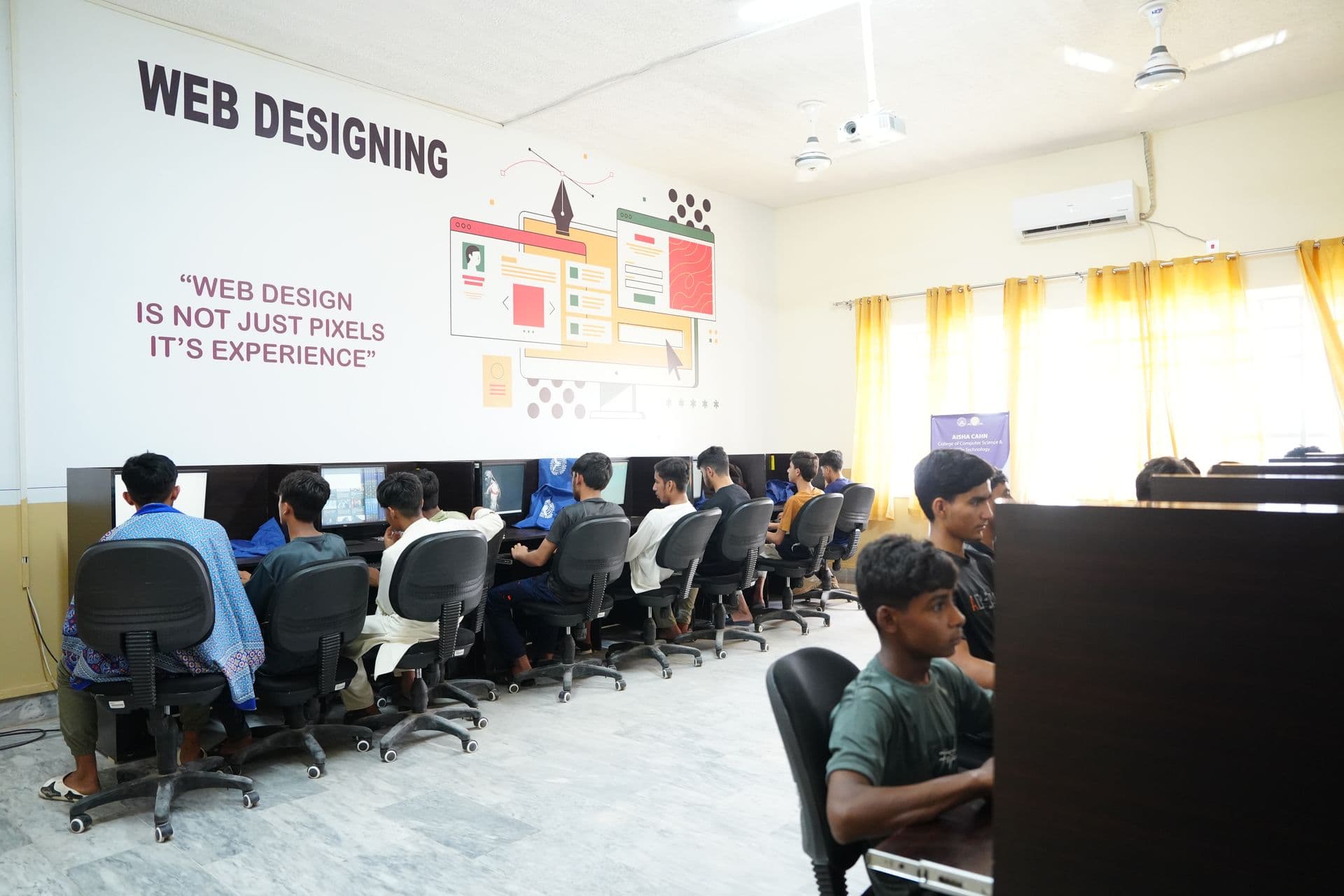
Three years ago this college was two courses and a first intake of students. The buildout since has been steady and deliberate, and this year it reached the part that tends to raise an eyebrow: an AI Lab Studio, in Wazirabad.
What has actually been built
The short version of the last three years:
- 2024 — the college opens with two courses and its first students.
- 2025 — eight computer labs, a tailoring studio, a fashion design studio, an on-site data centre, an e-library, and educational visits to Islamabad and Lahore.
- 2026 — the AI Lab Studio, this website, and a content system the college runs itself.
Fourteen programmes now run across those rooms. The lab is the newest of them, and the one that needs the most explaining.
The objection, stated fairly
It goes like this: artificial intelligence is a Lahore and Karachi subject. The companies are there, the salaries are there, and the people who have done the work are there. A college in a district city should stick to the skills its own market buys.
It is not a foolish argument. It is simply out of date. The work in this field is done on a machine and delivered over a network, and it is bought by employers who mostly do not care which city the person sits in. What a student in Wazirabad has actually been short of is not talent or appetite. It is a room with reliable machines, a connection that holds, and somebody in it who has done the work for a living.
That is a buildable list. So we built it.
What is taught in it
The AI track runs at every length the college offers, so it can be entered from wherever you happen to be standing:
- Python Programming and Data Analytics — four weeks each, the groundwork.
- Generative AI & Prompt Engineering — four weeks, for people who already use these tools daily and want to use them properly.
- AI Fundamentals — a certificate over three or six months. How modern AI actually works, rather than which buttons to press.
- AI Engineering — the one-year diploma. Language models, retrieval, agents, and getting a system to survive contact with real users.
The track is taught by Mr. Muhammad Musa Kaleem, who teaches here as a senior backend and MLOps engineer. That is the part a room cannot supply on its own, and the part that is hardest to arrange outside a large city.
Why a website counts as infrastructure
Listing a website and a content system next to a laboratory looks like padding. It is not. A college that cannot publish cannot be found, cannot show a prospective student what its classrooms look like, and cannot correct its own record when something changes.
This site is run by the college's own staff through its own content system — the programmes, the gallery, the people on the about page, and this article. Nobody has to file a request with a developer to change a course description or add a photograph. For an institution that intends to keep growing, that independence is worth as much as a lab.
What comes next
Three things are planned, in this order:
- Audio-visual rooms — built for lectures and screenings, and for lessons students can watch again afterwards.
- An incubation centre — space and support for students turning a skill into a business of their own.
- Reach beyond this campus — taking what works here to students in other cities.
The college exists because the Aisha Cahn Foundation and Muslim Hands believed that quality education should reach young people who would otherwise not get near it. A lab in a district city is what that belief looks like when it is built rather than said.
The gallery has photographs of the labs and studios as they are now. Visitors are welcome.